Cardiology’s ASC Moment
The Policy Shift Arrived All at Once
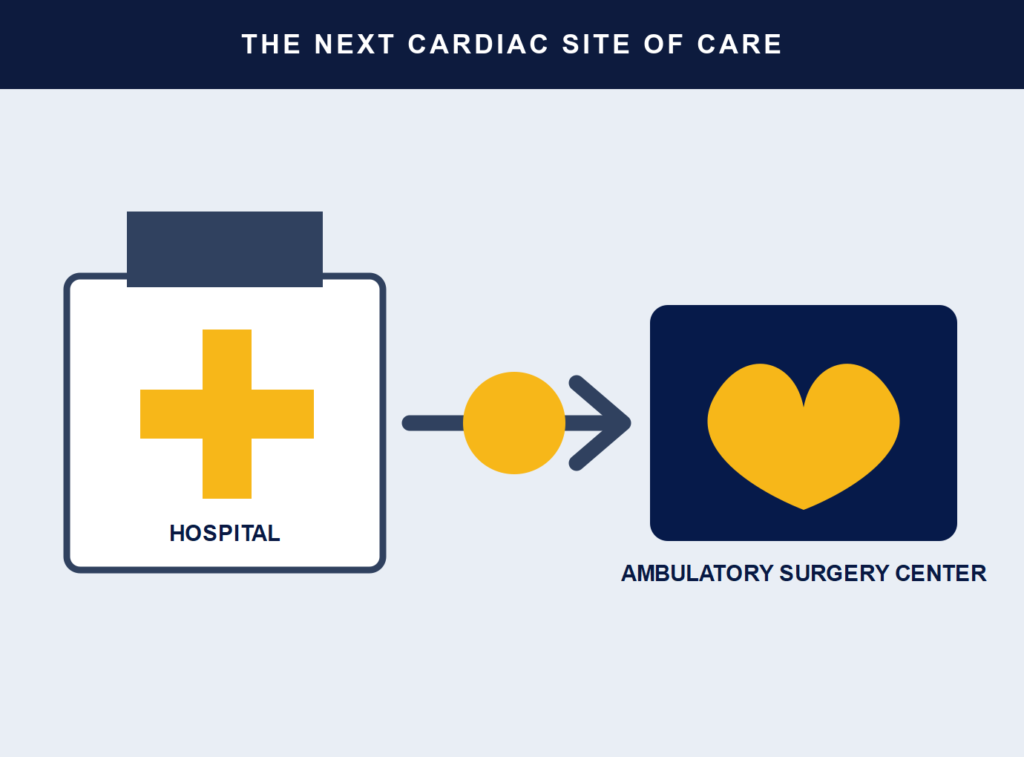
Cardiology’s migration to ambulatory surgery centers has been discussed for years. In 2026, federal payment policy moved decisively.
CMS added 573 procedures to the ASC Covered Procedures List: 302 under revised eligibility criteria and another 271 removed from the inpatient-only list. The additions include procedures that previously kept major parts of cardiovascular care inside hospital outpatient departments.
Electrophysiology
EP studies and intracardiac ablations, including atrial fibrillation, supraventricular tachycardia and ventricular tachycardia procedures.
93650936539365493656
Interventional Cardiology
Additional percutaneous coronary intervention codes, expanding the range of coronary cases eligible for ASC payment.
C9602C9604C9607
Supporting Cardiac Procedures
Cardioversion and transesophageal echocardiography can now accompany a broader ambulatory cardiovascular workflow.
929609331293318
Vascular Intervention
CMS also added vascular embolization or occlusion, extending the rule beyond cardiac rhythm and coronary care.
37244
What Changed CMS’s Mind?
In the 2025 final rule, CMS declined to add cardiac ablation, citing associated inpatient admissions and the possibility that patients could require monitoring past midnight. One year later, ablation was on the list.
Between those decisions, the clinical evidence became harder to ignore. A multicenter study examined 4,037 electrophysiology procedures performed at six ASCs, including 1,779 catheter ablations and 1,453 cardiac-device procedures.
The Safety Evidence
The difference in ablation adverse-event rates was not statistically significant. Urgent or unplanned hospitalization occurred after 0.45% of ASC ablations.
The Heart Rhythm Society and American College of Cardiology subsequently concluded that selected intracardiac ablations can be performed safely in ASCs when programs use structured patient selection, trained teams and defined escalation pathways.
That qualifier matters. Evidence that a procedure can be performed safely in a qualified ASC is not evidence that every ASC is ready to perform it.
Permission Is Not the Same as Readiness
Cardiac ablation brings requirements that are not standard in many surgery centers. The 2025 HRS/ACC scientific statement describes the infrastructure needed to support a safe program.
The Economics Create Momentum—and Friction
The financial case for migration is straightforward from the payer’s perspective. An industry-sponsored analysis of Medicare claims estimated that ASCs received, on average, 62% of hospital outpatient payment for the same procedures in 2024. It estimated cardiovascular procedures accounted for only about 9% of eligible ASC activity in 2023, leaving considerable room for migration.
But lower reimbursement does not automatically mean attractive economics for the ASC. Cardiac mapping systems, imaging equipment, anesthesia, specialized staff, emergency preparedness and high-cost devices can consume the apparent savings.
The most viable programs may therefore be centers with sufficient procedure density, experienced physicians and purchasing scale—or joint ventures able to combine ASC efficiency with health-system support.
The First Movers Will Not Be Random
Centers already performing cardiac-device implants, catheterization or PCI have much of the operating model in place.
Experienced operators with predictable case flow are better positioned to support the fixed cost of an ablation program.
Joint ventures can preserve referral and transfer relationships while moving selected cases into a lower-cost setting.
Geography will matter too. Markets with long hospital wait times, concentrated electrophysiology groups or limited access to tertiary centers may have stronger incentives to build ambulatory capacity.
Following the Shift in ClearSight
The policy change is national. Adoption will be local and physician-specific.
ClearSight Health connects physician procedure activity to hospitals, ASCs and OBLs, making it possible to identify which cardiovascular specialists already work across multiple sites of care and which facilities are building relevant case volume.
The same view connects those physicians to the training pipeline. Explore electrophysiology and interventional cardiology programs to understand where the next generation of specialists is being trained—and which faculty environments may normalize ASC-based care earliest.
Cardiology’s ASC Moment Has Begun
CMS has removed one of the largest barriers to cardiovascular ASC growth. The safety evidence supports selected procedures, and the economics create pressure to move appropriate cases away from hospital outpatient departments.
But the market will not shift simply because the codes are payable. The winners will be the centers that can combine lower-cost delivery with hospital-grade discipline around patient selection, staffing, equipment and emergency readiness.
The 2026 rule opened the door. What happens next will be determined one physician, one facility and one market at a time.
- Centers for Medicare & Medicaid Services. CY 2026 OPPS and ASC Final Rule, November 2025.
- Ambulatory Surgery Center Association. 2026 Final Payment Rule Includes Profound Procedure List Changes, November 2025.
- Aryana A, et al. Safety and Feasibility of Cardiac Electrophysiology Procedures in Ambulatory Surgery Centers. Heart Rhythm. 2025;22(3):717–724.
- Shanker AJ, et al. HRS/ACC Scientific Statement: Guiding Principles on the Performance of Intracardiac Ablation Procedures in Ambulatory Surgical Centers. Journal of the American College of Cardiology. 2026;87(14).
- Kramer CM, et al. Cardiovascular ASCs: Transforming Cardiovascular Procedural Care Through High-Value Ambulatory Models. Journal of the American College of Cardiology. 2026;87(16).
- Ambulatory Surgery Center Association/KNG Health Consulting. Medicare Savings From Use of Ambulatory Surgery Centers, May 2026.
- ClearSight Health Commercial Intelligence Platform. Physician, facility, site-of-care and fellowship-program profiles, accessed July 2026.
Methodology: Policy and code changes are based on the cited CMS final rule and ASCA analysis. Clinical outcomes come from the cited multicenter study and HRS/ACC scientific statement. The ASC-share and payment comparisons come from an ASCA-sponsored analysis and should be interpreted in that context. Forward-looking conclusions about adoption are ClearSight Health analysis.