The FFR Paradox: Why the Gold Standard Isn’t the Standard Everywhere
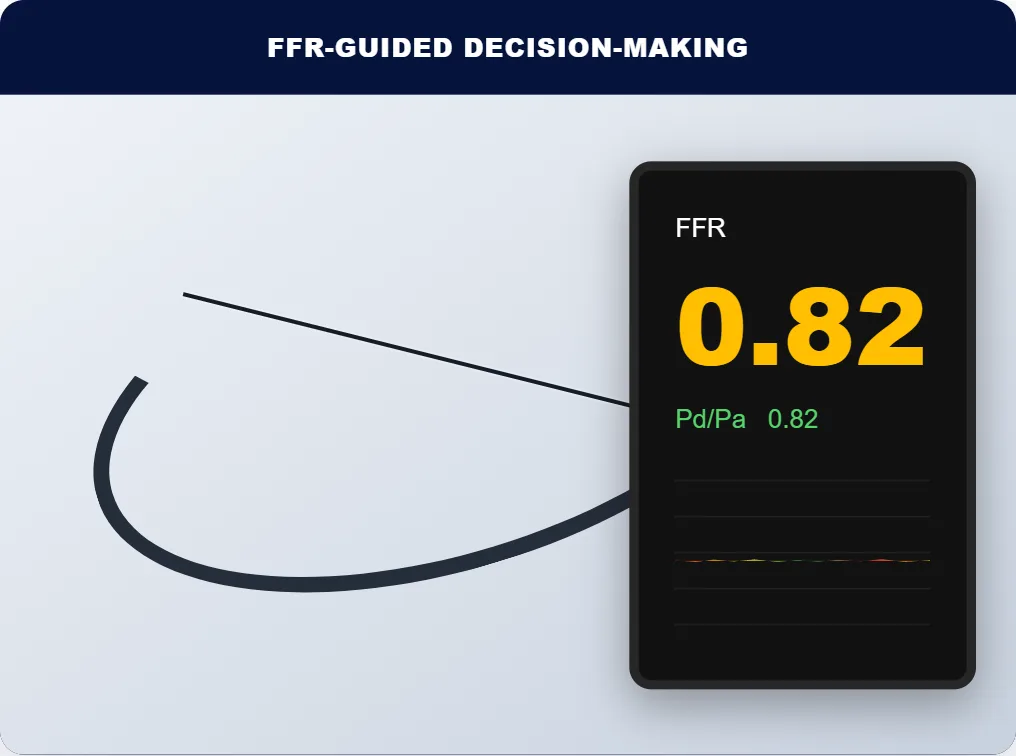
For more than two decades, Fractional Flow Reserve (FFR) has been one of the most extensively validated technologies in interventional cardiology.
By almost every measure, the clinical debate has been settled. So why isn’t FFR routine everywhere?
The Evidence Isn’t the Barrier
Decades of trials and guidelines support physiology-guided assessment.
The Literature Explains Why
Real-world utilization reveals who actually adopts it.
185,373 Procedures
Identified across 10,441 physicians and 2,289 facilities.
Adoption Is Concentrated
A small number of hospitals and physicians drive a large share.
Major clinical trials—including DEFER, FAME, and FAME 2—fundamentally changed how physicians evaluate intermediate coronary lesions.
They demonstrated that physiology-guided decision-making improves outcomes and helps avoid unnecessary PCI. Today, both U.S. and European guidelines continue to recommend physiologic assessment in appropriate patients.
The Evidence Isn’t the Barrier
Today’s discussion isn’t about whether FFR works. It’s about why its adoption remains so uneven.
Workflow. Procedure time. Physician preference. Institutional culture. Alternative technologies such as iFR, IVUS, OCT, and angiography-derived physiology all influence whether coronary physiology becomes part of everyday practice.
The literature explains why physicians should use FFR. It tells us far less about who actually does.
Looking Beyond the Clinical Trials
Clinical trials measure efficacy. Commercial teams need to understand adoption.
To answer that question, ClearSight Health analyzed 185,373 identified U.S. FFR procedures performed by 10,441 physicians across 2,289 facilities, with data refreshed through Q2 2026.
The pattern was unmistakable. FFR may be considered the gold standard—but its use is anything but evenly distributed.
FFR Is Concentrated
A relatively small number of hospitals account for a disproportionate share of FFR utilization.
Top 20 facilities perform nearly 14% of all identified FFR procedures.
Top 100 facilities perform almost 37% while representing less than 5% of facilities in the dataset.
Among the country’s highest-volume centers are:
| Facility | City, State |
|---|---|
| Cleveland Clinic Foundation | Cleveland, OH |
| St. Joseph Medical Center | Tacoma, WA |
| Piedmont Hospital | Atlanta, GA |
| Methodist Healthcare – Memphis Hospitals | Memphis, TN |
| WakeMed Raleigh Campus | Raleigh, NC |
| CHRISTUS Good Shepherd Medical Center | Longview, TX |
| NYU Langone Hospitals | New York, NY |
| Genesis Medical Center Davenport | Davenport, IA |
| St. Bernards Medical Center | Jonesboro, AR |
Facility names open the corresponding ClearSight platform profile in a new tab.
This concentration suggests that institutional practice patterns—not simply patient demand—play a major role in whether coronary physiology becomes standard practice.
The Same Pattern Exists Among Physicians
The physician data tells a similar story.
Although more than 10,400 physicians performed at least one identified FFR procedure, relatively few account for a substantial share of overall utilization.
Many of the country’s highest-volume operators practice at the same institutions leading national FFR adoption.
| Physician | City, State |
|---|---|
| Khaled Ziada, MD | Cleveland, OH |
| Samin Sharma, MD | New York, NY |
| Vikash Khurana, MD | Vincennes, IN |
| John Edward Blair, MD | Chicago, IL |
| Howard Levite, MD | Somers Point, NJ |
| Aland Fernandez, MD | Clearwater, FL |
| Wobo Bekwelem, MD | Minneapolis, MN |
| Laura Young, MD | Cleveland, OH |
| Freij Gobal, MD | Tacoma, WA |
Physician names open the corresponding ClearSight platform profile in a new tab.
Rather than reflecting individual preference alone, these findings suggest that adoption clusters around institutions where coronary physiology has become embedded in routine clinical practice.
The Real FFR Paradox
FFR is one of the strongest evidence-based technologies in cardiovascular medicine. Yet its adoption remains remarkably uneven.
The paradox isn’t whether FFR works.
It’s why two patients with the same coronary lesion may receive entirely different evaluations depending on where they’re treated and who performs the procedure.
For MedTech organizations, understanding that variation is just as important as understanding the clinical evidence. Clinical trials explain why FFR matters. Real-world utilization data reveals where coronary physiology has become standard practice—and where opportunities for growth still exist.
References
- Lawton JS, et al. 2021 ACC/AHA/SCAI Guideline for Coronary Artery Revascularization. Circulation. View source
- American Heart Association. Evidence-Based Practices in the Cardiac Catheterization Laboratory (2025). View source
- Tonino PAL, et al. Fractional Flow Reserve versus Angiography for Guiding Percutaneous Coronary Intervention (FAME). New England Journal of Medicine. View source
- De Bruyne B, et al. Fractional Flow Reserve-Guided PCI for Stable Coronary Artery Disease (FAME 2). New England Journal of Medicine. View source
- F(FR)² Registry Investigators. Real-world use of coronary physiology in clinical practice. View source
- ClearSight Health. Analysis of 185,373 identified U.S. FFR procedures performed by 10,441 physicians across 2,289 facilities. Internal commercial intelligence platform. Data refreshed through Q2 2026.