The Hospitals Winning the Class of 2026
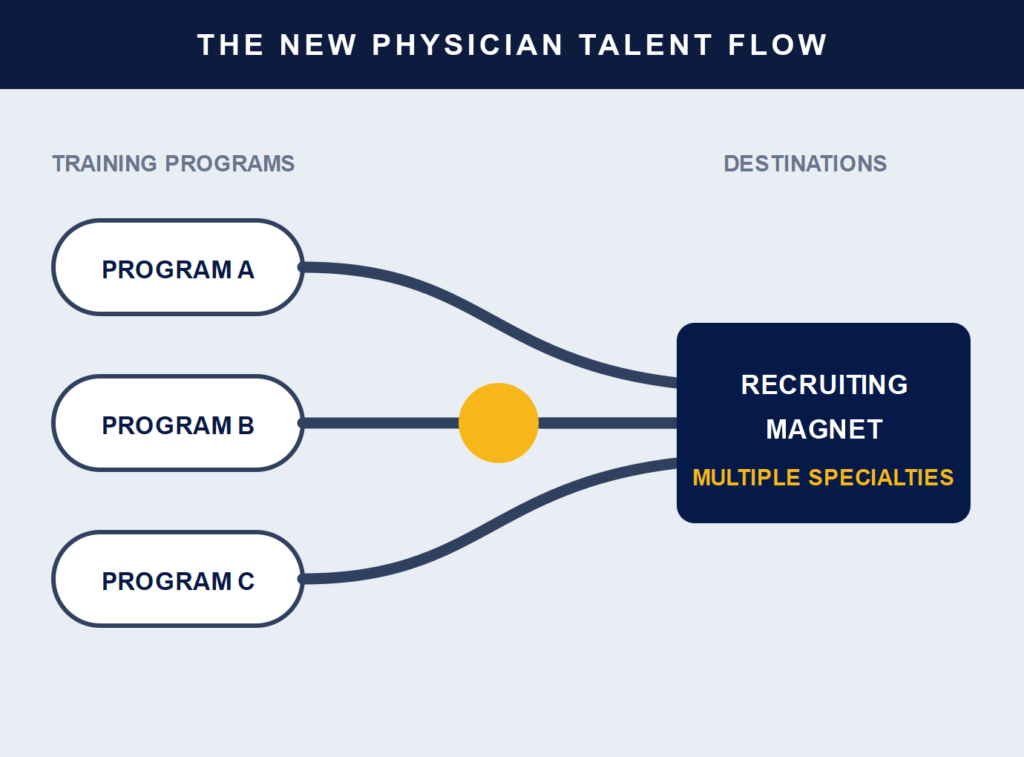
External research shows that physicians often remain near where they train. But procedural specialists also move for the right case mix, infrastructure, clinical team, and career opportunity.
That raised a more interesting question: which hospitals are attracting the Class of 2026 from beyond their own training pipelines?
Graduates Analyzed
Entering procedural practice
Practice Facilities
Identified destinations
Source Programs
Training origins represented
Stayed In State
Across the analyzed cohort
What External Research Suggests
The latest Association of American Medical Colleges data shows that 55.7% of physicians who completed residency between 2015 and 2024 practice in the same state where they trained. Training clearly creates a geographic pull.
For procedural specialists, however, the employment decision is more constrained. A national survey of recent pediatric surgery graduates found that case mix influenced 85% of job decisions, followed by geography, spousal employment, and compensation.
Training creates the network. The available procedural opportunity determines whether a physician can remain inside it.
So We Followed the Class of 2026
ClearSight linked 2,648 graduating procedural specialists to their identified practice facilities. As expected, several major academic centers led in absolute volume: Cleveland Clinic attracted 32 graduates, Mayo Clinic Hospital–Rochester attracted 31, and Massachusetts General Hospital attracted 30.
But the more revealing finding appeared below the top-line ranking. Several regional institutions recruited unusually broad incoming classes from many different programs, specialties, and states.
The Recruiting Magnets
| Destination Hospital | Graduates | Source Programs | Specialties | From Out of State |
|---|---|---|---|---|
| Vanderbilt University Medical Center | 15 | 12 | 11 | 60.0% |
| Corewell Health Grand Rapids | 11 | 10 | 6 | 63.6% |
| Indiana University Health | 10 | 10 | 8 | 80.0% |
| Morristown Medical Center | 10 | 8 | 6 | 70.0% |
| Carolinas Medical Center | 9 | 9 | 5 | 88.9% |
ClearSight Health analysis of identified 2026 graduates and practice destinations, July 2026. “Out of state” compares the graduating program state with the destination facility state.
The Most Surprising Finding
Carolinas Medical Center attracted nine physicians from nine different programs. Eight crossed state lines to get there. Its incoming class included orthopedic surgery, cardiovascular disease, interventional cardiology, advanced heart failure, and critical care graduates.
Indiana University Health showed even greater specialty breadth. Its 10 new procedural specialists came from 10 programs across eight specialties; 80% trained outside Indiana.
These are not simply large programs recycling their own graduates. They are hospitals assembling procedural talent from across the national training network.
Carolinas Recruits From Different Programs
IU Health Recruited Out of State
Specialties Added at Vanderbilt
Programs Feeding Corewell Grand Rapids
Not Every Winner Recruits Nationally
Strong Memorial Hospital represents a different model. ClearSight identified 24 graduates entering practice there across eight procedural specialties. Twenty-three trained in New York, and the group came from only three programs.
That concentration suggests a powerful regional pipeline rather than a national recruiting strategy.
External research indicates that this model may have lasting value. A 20-year study of Kaiser Permanente Southern California found that internally trained physicians had higher subsequent retention than externally trained hires: 82% versus 76%.
Some hospitals win by importing talent. Others win by keeping a regional training ecosystem intact.
There Is No Single Procedural Labor Market
Mobility differed substantially across the specialties examined. Spine surgery and adult reconstruction graduates were far more likely to remain in their training states than orthopedic surgery, vascular surgery, or urology graduates.
| Specialty | Remained in Training State | Moved Out of State |
|---|---|---|
| Spine Surgery | 63.1% | 36.9% |
| Adult Reconstruction | 56.6% | 43.4% |
| Cardiovascular Disease | 52.8% | 47.2% |
| Electrophysiology | 36.6% | 63.4% |
| Urology | 30.0% | 70.0% |
| Vascular Surgery | 26.1% | 73.9% |
| Orthopedic Surgery | 21.9% | 78.1% |
ClearSight Health analysis. These figures describe the graduating cohort included in this study and are not estimates of the entire specialty workforce.
The pattern is consistent with recent orthopedic research showing that geographic retention after fellowship varied from 21.9% in the Midwest to 68.7% in the Northeast. Specialty, region, and available opportunity all influence where physicians establish their careers.
Three Ways to Win the Graduating Class
National Magnet
Recruit beyond the local pipeline
Carolinas Medical Center and Indiana University Health drew nearly every identified recruit from a different program.
Capability Builder
Add breadth across specialties
Vanderbilt assembled an incoming class spanning 11 different procedural specialties.
Regional Pipeline
Keep locally trained talent nearby
Strong Memorial attracted a large incoming class overwhelmingly trained within New York.
The Hospitals Winning the Class of 2026
The largest academic centers still attract the greatest numbers. That was expected.
The more interesting finding is that some regional hospitals are recruiting well beyond their apparent training footprint—drawing procedural specialists from numerous programs, across multiple specialties, and from outside their home states.
Winning the graduating class is not only about size. It is about how far a hospital’s recruiting reach extends—and what new procedural capabilities arrive with each physician.
Why This Matters
A newly practicing procedural specialist brings more than headcount. Each placement can change local case capacity, referral patterns, faculty networks, and the future adoption environment for specialized technology.
By connecting physicians to their training histories and practice destinations, ClearSight shows which institutions are retaining local talent—and which are becoming unexpected magnets for the next generation of procedural specialists.
- Association of American Medical Colleges. Physician Retention in State of Residency Training, 2015–2024. AAMC.
- The Current Pediatric Surgery Job Market: A Perspective of Recent Fellowship Graduates. Journal of Pediatric Surgery. PubMed.
- Internally Versus Externally Trained Residents and Fellows Hired as Attendings at a Large Integrated Healthcare System. Human Resources for Health. Springer Nature.
- Geographic Retention and Gender-Based Trends Among Orthopedic Shoulder and Elbow Surgeons in the United States. Journal of Shoulder and Elbow Surgery. PubMed.
- ClearSight Health Commercial Intelligence Platform. Analysis of identified 2026 graduates and practice destinations, July 2026.
Methodology: ClearSight linked 2,648 identified 2026 graduates in the procedural-specialty cohort analyzed with their practice facilities. Facility comparisons measure incoming volume, source-program diversity, specialty breadth, and interstate movement. They do not represent a definitive net-gain ranking because training programs and destination facilities do not share a universal health-system identifier.