The Fellowship Effect: Why Nearly Every Orthopedic Surgeon Now Specializes
Orthopedic surgery has become one of the most specialized fields in medicine. Nearly every graduating resident now pursues fellowship training—a decision that shapes the procedures they perform, the technologies they adopt and the markets they will influence for years to come.
The educational trend is well documented. The commercial implications are only beginning to be understood.
Orthopedic Residents
Graduate each year
Continue to Fellowship
Published participation rate
New Orthopedic Fellows
Enter subspecialty training annually
Graduating Class
ClearSight analysis
The General Orthopedic Surgeon Is Becoming the Exception
Not long ago, completing an orthopedic residency was enough to begin independent practice.
Today, that path has become the exception rather than the rule.
Published workforce studies show that approximately 93% of graduating orthopedic residents continue directly into fellowship training, making orthopedic surgery one of the most subspecialized fields in medicine.
With approximately 963 orthopedic residents graduating each year, nearly 900 continue their training before ever entering independent practice.
For today’s orthopedic surgeon, one of the most important career decisions is not simply where residency was completed. It is which fellowship comes next.
Fellowship training is no longer optional. It has become the standard pathway into modern orthopedic practice.
Why Orthopedics Became So Specialized
Orthopedic surgery has evolved rapidly over the past several decades.
Advances in implant technology, minimally invasive techniques, robotics, biologics and increasingly complex surgical procedures have transformed orthopedic care into a collection of highly specialized disciplines.
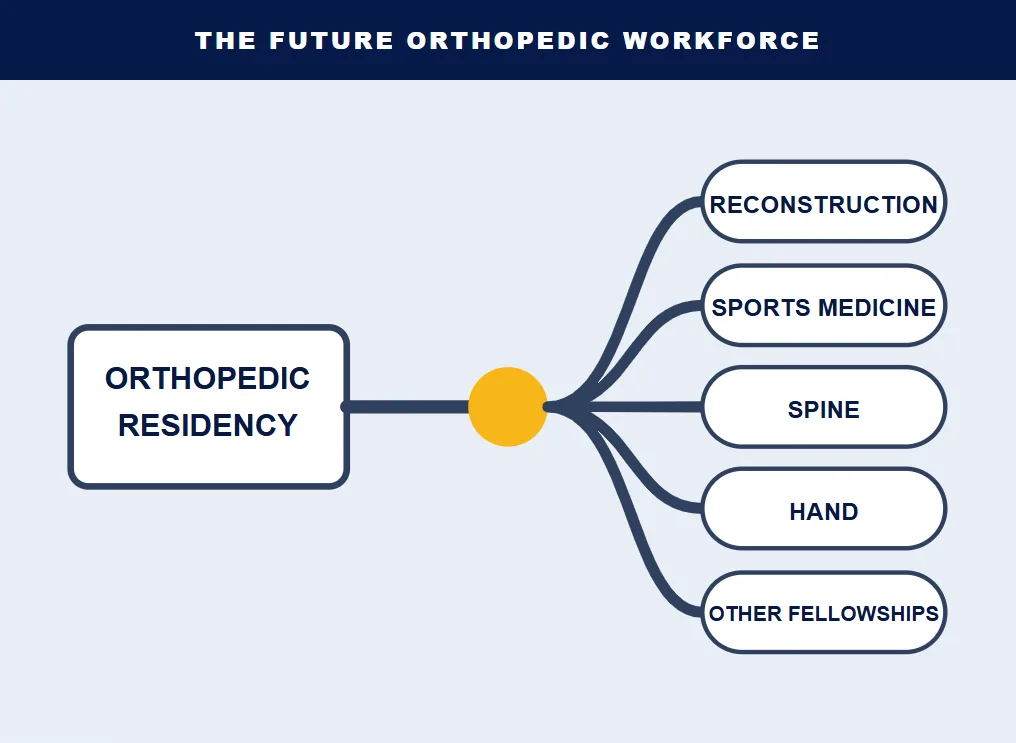
Today’s graduating residents commonly pursue fellowships in adult reconstruction, sports medicine, spine surgery, hand and upper extremity, orthopedic trauma, foot and ankle, shoulder and elbow, pediatric orthopedics and musculoskeletal oncology.
Each fellowship represents a distinct career path with its own procedural expertise, technologies, faculty mentors, referral patterns and commercial landscape.
Looking Beyond the Literature
The literature explains why fellowship training has become nearly universal.
Commercial organizations need to answer different questions.
Those questions cannot be answered through residency match statistics alone. They require longitudinal physician intelligence.
ClearSight Analysis
ClearSight analyzed the 2026 graduating orthopedic residency class to understand where tomorrow’s orthopedic surgeons are headed.
Of the approximately 963 orthopedic residents graduating this year, roughly 93% will continue into fellowship training, representing nearly 900 new orthopedic fellows beginning subspecialty training.
While orthopedic surgery offers numerous fellowship options, the 2026 class is concentrated among just a handful of specialties.
Where the 2026 Orthopedic Graduating Class Goes Next
| Fellowship | 2026 Fellowship Placements |
|---|---|
| Adult Reconstruction | 205 |
| Orthopedic Sports Medicine | 192 |
| Spine Surgery | 140 |
| Hand & Upper Extremity | 140 |
| Orthopedic Trauma | 71 |
| Foot & Ankle | 47 |
| Shoulder & Elbow | 44 |
| Pediatric Orthopedics | 43 |
| Musculoskeletal Oncology | 13 |
ClearSight analysis of the 2026 orthopedic residency graduating class and fellowship destinations.
Four Fellowships Dominate the Pipeline
Fellowship Shapes Future Practice
Most commercial datasets begin tracking physicians only after they enter independent practice.
By then, many of the decisions that influence future practice have already been made.
Understanding those relationships provides visibility years before physicians appear in traditional commercial datasets.
The Future Orthopedic Market Begins During Fellowship
Every year, nearly 900 orthopedic surgeons begin fellowship training.
Those physicians will become tomorrow’s sports medicine specialists, joint replacement surgeons, spine surgeons, hand surgeons, trauma surgeons and pediatric orthopedic leaders.
Long before they perform their first independent procedure, many have already established the mentor relationships, technical expertise and professional networks that will influence their careers for decades.
Understanding fellowship is not simply about education. It is about understanding where the next generation of orthopedic influence begins.
Why This Matters
Orthopedic markets are not shaped only when surgeons begin practice. They are shaped years earlier during training.
ClearSight connects residency, fellowship, faculty mentorship, career placement and future procedural activity into a single longitudinal view of physician development.
Rather than waiting until surgeons begin performing procedures independently, commercial teams can identify future specialists while they are still making the decisions that will define their careers.
Understanding where orthopedic surgeons go next provides a clearer view of where the orthopedic market is headed next.
References
- Daniels AH, et al. Trends in ACGME Accreditation of Orthopaedic Surgery Fellowship Training. Orthopedics. 2023.
- Hariri S, et al. Is Subspecialty Fellowship Training Emerging as a Necessary Component of Contemporary Orthopaedic Surgery Education? Clinical Orthopaedics and Related Research.
- National Resident Matching Program. 2026 Main Residency Match Results.
- ClearSight Health Commercial Intelligence Platform. Analysis of the 2026 orthopedic residency graduating class and fellowship placements, Q2 2026.