From Scalpel to Catheter: How Cardiothoracic Training Is Changing
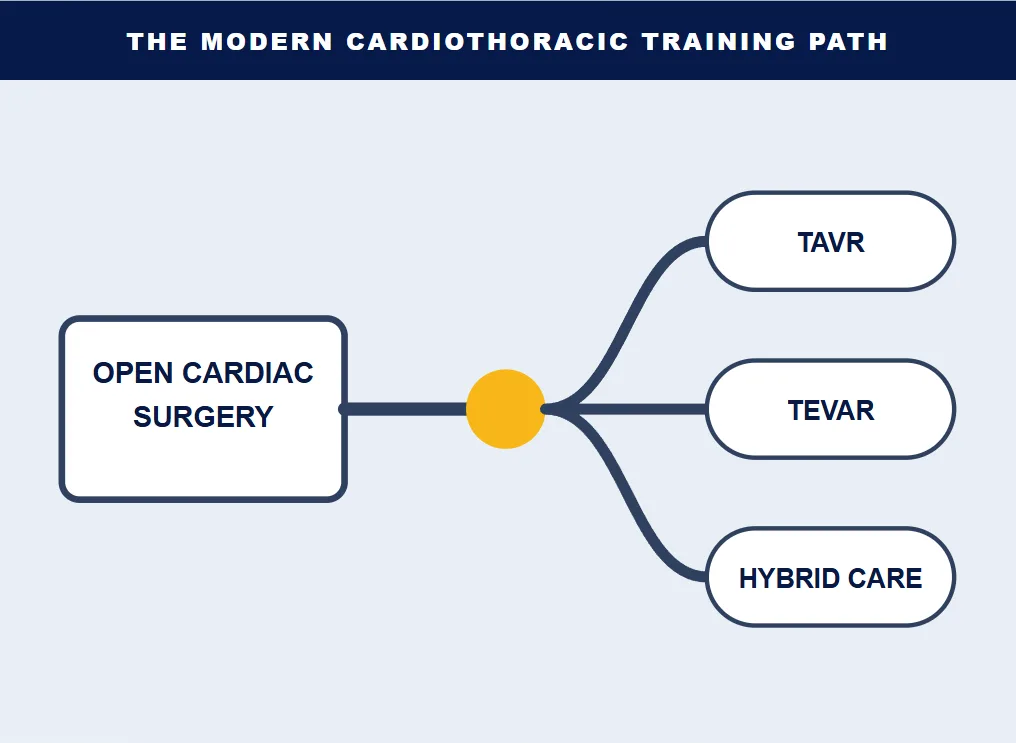
Not long ago, the path to becoming a cardiothoracic surgeon was remarkably consistent. Residents learned coronary artery bypass grafting, surgical valve replacement, aortic surgery and other complex open-heart procedures. Catheter-based interventions belonged to interventional cardiologists.
Today, that distinction is fading—and not every training program is evolving at the same pace.
Graduating Fellows
2026 ClearSight analysis
Training Programs
Cardiothoracic pathways tracked
Unique Institutions
Across the U.S. training landscape
Months of Catheter Training
Average reported exposure
TAVR Changed More Than Valve Therapy
When Transcatheter Aortic Valve Replacement (TAVR) was first approved in the United States in 2011, it was reserved for patients considered too high risk for surgery.
Fifteen years later, TAVR has become a cornerstone of aortic valve therapy. Annual procedural volume grew from fewer than 5,000 procedures in 2012 to nearly 100,000 by 2022, and is now estimated to exceed 120,000 procedures annually in the United States.
But TAVR did something even more profound.
It reshaped the role of the cardiac surgeon.
Rather than replacing surgery, TAVR accelerated the development of multidisciplinary Heart Teams, where cardiac surgeons and interventional cardiologists jointly evaluate patients, determine the optimal treatment strategy and collaborate in structural heart programs.
The Modern Cardiac Surgeon Practices in Two Worlds
Open surgery remains the foundation of cardiothoracic training.
Complex valve surgery, CABG, aortic reconstruction, transplant and mechanical circulatory support continue to require technical expertise that cannot be replicated through catheter-based techniques.
At the same time, many cardiac surgeons now work within hybrid operating rooms and structural heart programs, participating in procedures such as:
The profession has expanded from mastering the scalpel alone to understanding both open and catheter-based therapies.
Not Every Fellowship Offers the Same Experience
Although structural heart has become a defining part of modern cardiovascular care, training exposure remains highly variable across cardiothoracic programs.
A 2024 study published in JTCVS Structural and Endovascular surveyed cardiothoracic trainees and program directors across the United States. The findings revealed substantial differences in catheter-based training:
Many trainees primarily served as assistants rather than primary operators, and only a small minority felt comfortable independently performing structural heart procedures by graduation.
Every graduate earns the same certification. Not every graduate leaves with the same procedural exposure.
Looking Beyond the Literature
The literature establishes that structural heart exposure varies.
Commercial organizations need to answer the next question:
Those questions require more than accreditation lists or program descriptions. They require training data connected to physician-level procedural activity.
ClearSight Analysis
ClearSight analyzed the 2026 cardiothoracic training landscape and connected fellowship programs to the procedural activity of their affiliated faculty.
The analysis identified 185 graduating fellows across 115 training programs at 83 unique institutions.
Top 5 Cardiothoracic Programs by Faculty TAVR Volume
| Program | Faculty TAVR Volume |
|---|---|
| Cleveland Clinic Foundation | 1,003 |
| NYU Grossman School of Medicine | 828 |
| Albany Med Health System | 799 |
| Tufts Medical Center | 791 |
| Icahn School of Medicine at Mount Sinai | 573 |
ClearSight Health analysis of cardiothoracic training programs and affiliated faculty TAVR activity, Q2 2026.
What the Ranking Reveals
Where Training Happens Shapes What Comes Next
Cardiothoracic surgeons may graduate with the same certification, but they do not all train inside the same procedural environment.
Fellows surrounded by high-volume TAVR faculty are more likely to observe multidisciplinary decision making, hybrid workflows, device selection and the operational realities of structural heart care.
Training does not determine a surgeon’s future practice—but it is one of the earliest signals of the technologies, mentors and clinical models shaping that future.
Why This Matters
Commercial organizations have traditionally identified physician expertise after physicians enter independent practice.
But procedural expertise often begins years earlier.
ClearSight connects training programs, faculty relationships, career progression and physician-level procedural activity into a single longitudinal view. That makes it possible to identify where tomorrow’s cardiothoracic surgeons are being exposed to structural heart care before they appear in traditional commercial datasets.
For MedTech organizations focused on structural heart, aortic intervention and advanced surgical technologies, understanding where surgeons train may be just as important as understanding where they ultimately practice.
References
- Lee G, et al. Exposure and Subspecialty Training in Transcatheter Structural Heart Procedures for Cardiac Surgeons: An Evolving Necessity and Training Requirement. Canadian Journal of Cardiology. 2024. PubMed.
- Vinholo TF, et al. Cross-sectional Study on Structural Heart Training Experiences in Cardiothoracic Residency Programs. JTCVS Structural and Endovascular. 2024. ScienceDirect.
- CTSNet. Cross-sectional Study on Structural Heart Training Experiences in Cardiothoracic Residency Programs. CTSNet.
- American College of Cardiology. National Variation in Hospital MTEER vs. TAVR Outcomes. 2024. ACC.
- ClearSight Health Commercial Intelligence Platform. Analysis of the 2026 cardiothoracic training landscape, graduating fellows, training institutions and affiliated faculty TAVR activity, Q2 2026.